It's a great read, and I couldn't help myself but leave a comment.
My favorite comment is Robert Ulrich's suggestion for a t-shirt slogan.
Did you read it?
OK: Imagine you're having a conversation with some people about an animal.
Only you think the animal in question is an elephant.
And the next person thinks it's a snake.
And the next one a fish, and another person thinks it's a snail but you all think you're talking about the same thing...
'It wouldn't scare me if I woke up with it on my bed'
'Oh, I wouldn't fancy that much!'
'I'd have to rush out and get it a bowl of water'
'Wouldn't scare you? Bowl of water? You're all nuts, I'd be out of there in a shot to get my gun'
'That's a bit extreme'
That's why conversations about art so often go nowhere.
Everyone knows what real art is, but it's a different animal in every person's mind.
Pick ten things that make something art.
How would you arrange them if you had to put them on your fridge door in a certain order?
Most important first, least important last, to satisfy your idea of what makes something art.
Here's a few to pick from to get you started...
Clever. Funny. Understandable. Concept. Well known. Skill. Liveliness. Handmade. Popular. Shock value. Beauty. Message. Famous. Artist's reputation. Connecting emotionally with the viewer. Detail. Simplicity. The story behind it. The esteemed critic's explanation of it. Uncompromising. Price. Market value. Virtuosity. Craftsmanship. Artistry. Made it look easy. Looks really hard. Inspired. Incomprehensible.
Or anything else I haven't thought of, if those options don't help you find your ten.
Then start a debate about the role of assistants in the making of art.
Or any debate about art, for that matter!
Like what is it?
Unless you're talking with a bunch of people with very similar looking fridge doors to yours, the passionate debate could be heading in a thousand different directions the minute it starts!
If you don't like Picasso you're in denial.
So says V.S. Ramachandran, who's a neurologist investigating scientific explanations as to how and why we respond to art.
Of course I don't agree, and I'll explain why.
(skip to about 1:17 onwards for the Picasso bit)
It's as long as a movie, so I watched it in short bursts of ten minutes or so at a time since I have the attention span of an aphid, but it's fascinating. Definitely well worth watching the whole thing.
I'm going to paraphrase a lot, so watch the lecture for the man in his own words.
He points out how certain rules of thumb that are present in art relate to and stimulate certain known areas of the brain which have very specific functions.
For example, he suggests that multiple views of the face in one image, such as you see in cubism, stimulate brain cell a) frontal face recognition, brain cell b) profile recognition, and brain cell c) three quarter view recognition, all which then go to a master cell for remembering or recognizing an individual's face, which gets 3 times the stimulation as normal.
So cubist art has an intense effect on our more primitive brain which then stimulates an emotional response.
One thing he wants to do is explain Picasso's genius, and his arguments hinge on his assumption that his key prediction will turn out to be true.
That prediction, which is untested so far, is that everyone will have a measurably excited skin response to Picasso (which is unconscious).
This is of course because Picasso is a genius.
The skin response shows that the work is having an emotional effect on our 'primitive brains'.
But he is assuming Picasso is a genius.
I propose that notion is a con.
Anyway, he predicts our response would be like how seagull chicks get over excited by an abstracted and exaggerated representation of their parent's beak.
The parent bird's yellow beak has a bright red spot on it.
Three red stripes (instead of one red spot) on a rectangular yellow strip (not even beak-shaped), presented to a chick without the rest of its mother being present, excites a begging response even greater and more frenzied than the response to the normal real beak of the chick's actual mother.
If seagulls had art galleries, Ramachandran points out, they would all worship the artist who made a long yellow rectangle with 3 red stripes on it and pay millions for it, without knowing why.
The reason why is that the brain ignores irrelevant details, focusing the chick's attention on the key visual element of importance; the recognition of the beak.
And it's made even easier for the chick by not even needing to recognize the beak's shape, only a key element or two (red spot on yellow background).
And now it's got 3 times the stimulus (3 red stripes) so it gets over stimulated and goes nuts.
The thing is, lots of people I know don't like Picasso.
Some who don't like his work may begrudgingly admit he must be a genius since the experts say it's so.
But does Picasso really tap into the 'primitive brain' as Ramachandran assumes (ie IS Picasso a genius?), or did his work instead appeal to elaborate intellectual theorizing, while having little visceral effect (ie have we been conned)?
Did the adoption of his art by intellectuals become the reason for him being proclaimed a genius by those same people who were busy doing the theorizing?
I'm guessing V.S. Ramachandra has 'bought into' the established opinion of Picasso as genius, and therefore assumes Picasso is a great artistic genius, and expects his skin test results to prove it.
I think it would be funny if the results showed no more response to Picasso than to average 'control' tests.
And when asked why some people don't like Picasso, Ramachandran says that they do like Picasso on a visceral, underlying, more primitive subconscious level, but they don't let themselves admit it because the more advanced modern brain tells them it would be silly to like something that doesn't look real, or other reasons like that.
Our reasons for not liking it are revealed as 'the emperor's new clothes'.
We're just kidding ourselves that we don't like it.
He says we're in denial if we say we don't like Picasso.
But that's only if his assumption of Picasso's artistic genius is correct.
But what if it turns out his assumption is wrong?
What if it's the case that Picasso appealed to the 'higher brains' of the intellectuals of his day, which allowed them to get all Freudian with their theories (or whatever was the fashion at the time), while Picasso's work was actually leaving people's primitive brains un-tickled?
That trend (incomprehensible art-speak about incomprehensible imagery) would seem to have accelerated since Picasso's time.
If testing shows that to be the case, the emperor's 'new clothes' would turn out to be the opposite:
It would be Picasso's genius that turned out to be phoney, people only believing it because they've been told to by experts all this time.
I think a lot of testing will shed a lot of light over time. I'm very interested to find out what results show about people's underlying, physically measurable responses to various artistic stimuli.
I think that during testing people shouldn't know if they are looking at touted geniuses or vilified hacks or the work of kids or even animals during the testing. And control elements should of course be added of simple photos of faces, people, nudes, objects, hard to discern photos of unusual viewpoints of ordinary objects, almost random photo's of mud puddles, blurred bushes, as well as ordinary viewpoints of ordinary objects, and unusual objects, etc etc.
With a great deal of data and analysis, some predictable, repeatable effects to certain stimuli will no doubt be discovered.
If it turns out my, and many other people's smart modern brains don't like Picasso while our primitive brain responds, I can live with that. OK Ramachandran, I must be in denial!
If it turns out people's smart modern brains have been convinced that Picasso is a genius, while their primitive brain shows no significant response, I can live with that too.
I'd be surprised if it wasn't the case.
I read that Picasso made 86,000 artifacts.
Out of 86,000 completely random artifacts taken by a camera on a timer attached to a roaming cat I suspect some would stimulate the primitive brain by pure chance!
So some response, to some of anyone's work would be expected. But enough to be hailed a genius? How much would that take?
For instance, a photo of a bush with say a rock behind it (accidentally taken by the cat) would stimulate our primitive desire to make sense of partially obscured objects (is that a lion?).
I'm curious to see if I just 'don't get it' with regard to so much modernism, and other -isms, or if the hypothesis that people have been getting the wool pulled over their eyes for a long time is true (I suspect it is).
My curiosity can live with either outcome.
I'll keep doing doing what has value for me all the same.
This kind of stuff is really interesting. Science should try and tackle all natural phenomena in my view, including what makes us tick. I'm glad V.S. Ramachandran is having a crack at this no-man's land in his enthusiastic way, I know I'm capable of self delusion, as are many others.
I also know people are susceptible to accepting all sorts of things for all sorts of reasons.
Even things that seem to make no sense on any level.
So am I in denial or not? I suppose only time and lots of testing will tell...
p.s. I recommend listening to all of V.S. Ramachandran's lecture since my paraphrasing hardly does the man justice! His delivery is great, too!
Why is there more bad art today than there used to be?
Because the definition of art has been thrown so wide open, nothing gets left outside.
You can call the best stuff in the drawing room art, but you can’t deny the contents of the toolshed, compost heap and the outhouse being called art too, not if they demand to be.
So fine, it’s all art. The good, the bad and the ugly.
And now of course, even the smelly, too.
Lots more stuff calling itself art equals lots more bad art.
By the same token, there should be lots more good art, too, presumably.
Like me, I imagine your idea of what counts as good art you'd enjoy reflects your tastes and values that you either grew up with or have chosen to adopt.
In my case (for better or worse), it would be something excellent that stands above the crowd of mediocrity.
Probably came from a craft which demonstrates a high level of skill, shares my impeccably good taste (of course!) and has an emotional impact on enough viewers that it wasn’t an accident, whether the viewers are fellow craftspeople or not.
Good design, pleasing composition, interesting visual ideas.
The combined results of study, practice and talent.
These things would count for me.
They are present in all the artists I admire, and are at least what I try to put into my own work.
Which is not to say everything else isn’t art, of course.
It just wouldn’t likely be popping my cork.
Fortunately there’s plenty of what I’d call good art around that I can enjoy.
But also of course an awful lot of art I wouldn’t call art at all.
There would have been plenty more bad art back in the day too,
if only they’d been 'smart' enough to call it art!
End of rant!
I’ve made a couple more mid sized (4” long-ish) turtles, but since there’s no chance of them getting cast before the holidays, I’ll just leave them to one side for a while, and work on some more tree frogs which are coming along nicely so far (fingers crossed).
The real one I have as my muse got an apartment upgrade recently.
I rubber cemented a long oval plastic flower pot to the floor of the tank, so when I put water in the tank it doesn’t get inside the pot.
Inside the glued-in empty pot is a same sized pot with a bromeliad and some compost in it, which I can lift out if I need to.
I put a heater in the water, so now the water is nice and toasty warm, which heats the air above and creates a dripping wet humid environment that my frog loves.
To slightly mis-quote Edmund Blackadder, ‘It’s as damp in there as a pair of armored trousers after the hundred years war’.
My frog now emerges from the cosy spot in the bromeliad every evening without fail, to crawl about on the vines and leaves in search of crickets.
I dream of making our shower into a walk-in tree frog home, with branches, waterfalls, plants, sculpted backgrounds, a pebble filled pool, ahhh..., I wonder when Meridee has any extended painting trips planned…
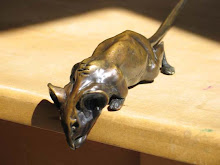
Oh, I'm going to run another contest to give away another mouse, but I'm only announcing it to people who have signed up for email updates. So if you fancy your chances, sign up in the side-bar where it says 'get email updates' (it's secure) and I'll announce the new contest in the next few days (besides that email updates are monthly).
Max Love from Kerrville, TX won last time, and had this to say...
'I received the mouse yesterday afternoon. :)
It is a truly remarkable little sculpture. He will have a good home.
Much thanks on your craftsmanship,
Max.'
Any art with a great sense of style, character and accuracy gets my vote every time.
Drape that over a compelling idea and you’ve really got a winner.
I prefer naturalism, but not for its own sake. For me it has to be done well.
The good stuff in any genre is always harder to find (but easy to spot when you find it).
Since I have a great respect for craftsmanship in the arts I am more drawn to work that is stylishly and expertly executed, with great character and flair, and with naturalism as its starting point.
The work can have departed quite wildly in the final incarnation, but I like it better when the initial impulse to create it was inspired by a natural emotionor something else in nature I can relate to.
I usually prefer that to visual work which is attempting to communicate some intellectual notion or mental concept.
For the most part I think words are better at doing that.
Like philosophy for instance.
Which might explain why a critic’s interpretation of some art seems more important than the art itself. When the words speak, but the art doesn’t. And art that says nothing gives the critic more freedom to say what’s on his mind.
A worthy idea for a piece of art could be as simple as communicating an animal or person's character or personality. Of course it could be a good deal more complicated too.
I love it when a piece of art stops me in my tracks with a sense of awe and wonder.
When it seems obvious the artist was inspired, but also skillful enough to pull it off.
That's why my favorite art criticism is simply ‘wow’.
There's a gallery in town with bronze dogs by two different artists. The gallery director (not the owner) told me one wouldn't rate as 'fine art' with her since they're just dogs being dogs, whereas the other she would describe as 'fine art' because it's not just being a dog, it's more arty and it has an idea.
I said for my money the dogs being dogs had character, personality and were more finely sculpted with a great deal of style. While the arty one seemed quirky more than fine. Maybe the fineness of the idea eluded me.I said, since I thought they were very finely made, I'd call the regular dogs 'fine art', and the other one 'quirky art'.She mentioned that the quirky/arty one she had been championing had been her choice to bring in to the gallery, so that may have explained her harder sell!
On a different note, my hoodrat is now finished and installed, and as soon as I get a nice sunny day to get some pics of him showing off around town I'll post a few!
Besides art, I like critters.
They're interesting to watch, and fun to make. So when I'm not doing anything else (like drawing storyboards) I'm usually either watching or making critters of some sort or other.